10/16/12

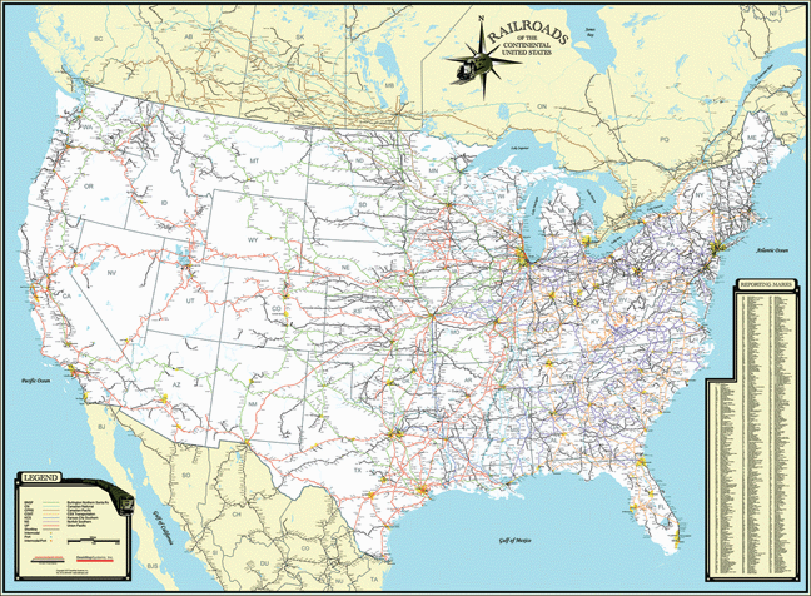
Blogger watching rail stocks


This interested party has shouted frustration with the train as it continues to complicate traffic in The Gap and sustains the risk of spills in downtown Rapid City.

There is an abandoned right of way that used to connect Sioux Falls and Rapid City with passenger service: it mostly parallels I-90, one of the largest carbon-based fuel black holes in the cosmos.

Minnesota Public Radio has been following fast-tracking development of light rail. Amtrak is reporting 300% ridership increases in some markets.

CSX is an underwriter of NPR: it's a railroad making money.

Richard Piersol at the Lincoln JournalStar:
Berkshire Hathaway's recent discovery that it owned a couple of short-line railroads in Iowa and Oregon has led to questions about the legality of its acquisition of BNSF Railway. Sen. John D. "Jay" Rockefeller IV, a West Virginia Democrat who is chairman of the Senate Commerce, Science and Transportation committee, wrote a letter to the federal Surface Transportation Board essentially backing an organization of captive shippers, Citizens United for Rail Equity, which says Berkshire's ownership of the short-line railroads in Council Bluffs, Iowa, and Oregon meant it needed STB approval before it bought BNSF.
Yes, there is railroad real estate connecting Santa Fe with Rapid City: a set of rusty, maybe-active tracks in the historic rail bed now owned by Canadian Pacific terminates on BNSF's holdings at Dakota Junction, Nebraska.

The speed limit on Nebraska 71 is 60 miles per hour on the 75 miles of bone-dry high prairie grassland between Crawford and Scottsbluff: it's potentially deadly during a blizzard.

US18/US85 between Hot Springs and Lusk, Wyoming is no better; besides, I-25, especially through the Denver metro, sucks at biblical proportions: so does flying through DIA with its likelihood of a strip search.

Construction on the estimated half-billion dollar Heartland Expressway connecting Rapid City with I-80 in Nebraska or Wyoming (nobody knows) is glacial if not completely stalled while traffic between the Black Hills and Denver continues to increase as does the volume between Denver and Santa Fe. Amtrak goes over (sometimes under) Raton Pass. The New Mexico RailRunner connects Santa Fe with ABQ and the Southwest Chief.

Moving coal is hardly sustainable: why not move more humans by making more commutes and seasonal migrations ground-based?

Imagine a time when portions or all track is elevated for wildlife egress through a future corridor between the Canadian River in New Mexico and an Amtrak station near the Missouri River in North Dakota then on to the Yukon River in Alaska intersecting with a tunnel under the Bering Strait connecting South and North America to Russia.

Follow Progressive Railroading or visit their site.

Here are the percentages of return on investment for several railroads.

Update, Amtrak ridership is funding subject of legislature: Indiana Public Media.

10/13/12

Lee Atwater guiding GOP from the grave


Listen to part of the basis for what Michelle Alexander calls the New Jim Crow at WYNC's On the Media:
Lee Atwater became one of the most complicated and successful Republican political operatives in history by employing a triple threat: spin when you can, change the subject when you can’t, and if all else fails, appeal to the voters’ resentment and fear, usually of African-Americans. In this conversation from 2008, Brooke talks to Stefan Forbes, director of "Boogie Man: The Lee Atwater Story", about the dark legacy of Atwater’s Southern strategy.
Just wow.

10/12/12

Feds to hear medical cannabis case


NPR's Talk of the Nation will host a discussion beginning at 12:00 MDT of a case pending in federal court:
Next week, interest group Americans for Safe Access will present the scientific case for marijuana's therapeutic effects to a federal appeals court, in hopes of relaxing federal restrictions. Oncologist Donald Abrams reviews the evidence on cannabis.
Spliced from Karen McVeigh's piece in the Guardian:
Oral arguments in the case are scheduled to be heard at the US court of appeal for the DC circuit on October 16. It marks the first time in 20 years the scientific evidence regarding the therapeutic value of marijuana will be reviewed by the courts. Previous efforts have not been successful. Four states have filed petitions to reschedule the drug, including Washington, Rhode Island, Vermont and Colorado.

Montana, Wyoming, New Mexico, and South Dakota home to older doctors: RT @StateImpactID.

10/10/12

USFWS/landowner partnership preserving South Platte


Colorado 71 crosses the South Platte a few miles southwest of Willard and just north of Brush: a Borg tendril intersecting a threatened ribbon of green.
The Partners for Fish and Wildlife (PFW) program was officially established by the U.S. Fish and Wildlife Service in 1987. A group of Service biologists and numerous conservation partners had the vision to look beyond the boundaries of government fee-title holdings and see the need to work cooperatively with private landowners. They recognized that nearly 73 percent of U.S. lands are in private ownership and a vast majority of federal trust species used these areas during their life cycle. Intense stakeholder outreach concluded that the most effective way to achieve conservation success was to provide direct financial and technical assistance. --Matthew Filsinger and Joe Milmoe, USFWS
Lifted this morning from a release of the USFWS Office of External Affairs:
Although the science behind groundwater recharge is complex, the concept is relatively simple. Place water in wetlands at a predetermined distance from the river and when the water seeps into the ground, it will follow underground geological paths, providing base flows back to the river system. On the South Platte, this water supports a number of human users, as well as a variety of threatened and endangered species, including: whooping crane, interior least tern, piping plover, and pallid sturgeon.

PFW has been able to assist in designing the wetlands, resulting in numerous gains for wildlife along the South Platte. The program has accomplished this by developing a technique to distribute the water in a functional manner, resulting in a wetland with a large surface area and shallow depth. By keeping the depth at two feet or less, it has become a great draw for a suite of migratory waterfowl and shorebirds. 
Species richness and diversity numbers are relatively high and attest to the productivity of the design techniques implemented by PFW. Together with numerous landowners and irrigation companies like the Platte River Recovery Implementation Program (PRRIP), the PFW program is leading the way for species recovery.
Whether it likes it or not, South Dakota and its wildlife killing game management arm is in this partnership with the US Fish and Wildlife Service, too. Yes, the state is bound to help support critical habitat.

Even some private landowners believe cooperation beats the hell out of litigation.

Scott Faver of the Environmental Working Group writes in The Hill:
While the middle class incomes are falling, net farm income has exploded – from $85 billion in 2008 to $122 billion in 2012. Median farm household income increased by 5.4 percent in 2011 and is expected to increase again this year. The income of the largest farms increased by nearly 8 percent in 2011 and is expected to soar again by year’s end.
Hmmm. Subsidies tied to environmental protection and habitat preservation: what a concept.

10/9/12

Tester smokes Rehberg; Seabrook: the news is broken...too

Update: Tester Torches Rehberg.


Montana Public Media aired the debate last night in Billings between Senator Jon Tester and his opponent: it wasn't even close.

Denny Rehberg remained incoherent: his mumbling at the podium was often inaudible and his sentences incomprehensible. As was the case in the US House debate, the Libertarian candidate was not invited. Montana Public Radio streaming on iTunes was my medium of choice for the broadcast.

From a piece penned by Chuck Johnson at Lee Newspapers of Montana:
“It was rock 'em, sock 'em,” said David Parker, a Montana State University political scientist who is writing a book on the race. “It was tough. They both stayed on their message.”
Parker was tapped for this morning's NPR story on the volume of money in the race in light of a recent Montana court decision striking down the state's limits on campaign contributions.