2/13/16

Red state collapse: Black Hills cougar extermination continues

A white christian trophy hunter has illegally slain a three-month old, fourteen pound cougar kitten in the Black Hills. The incident is par for the course in Lawrence County where alcohol with meth chasers and firearms are as common as sibling marriages.

The idiot was cited for a class one misdemeanor improper tagging, which carries a penalty of fines to $1,000, one year in jail and loss of hunting privileges for a year. If the judge is pissed off enough the perp could face additional charges once the investigation is complete.

Fifteen females and ten males have been slaughtered so far; more snow means more deaths.

This year South Dakota's Republican-owned wildlife killing department has lowered its sights from seventy five dead to sixty. Cougars and the American Dipper have been all but extirpated from the Black Hills, so have the threatened northern long eared bat and black backed woodpecker.

With Gaia's mercy the killing derby ends on March 31st without further loss of life.

Why is South Dakota's weather so brutal and unforgiving? Because South Dakotans deserve it.
2/11/16

Trump, Sanders running neck and neck in South Dakota Facebook primary

Senator Bernie Sanders is ahead of Donald Trump in Lawrence, Oglala Lakota, Clay, Todd, Roberts, Dewey, Corson and Brookings Counties. Trump is leading Sanders by only four points overall in South Dakota's Facebook primary.

Check it out.

EWG: voluntary conservation efforts are being plowed under


The Supreme Court of the United States has put a hold on President Obama's Clean Power Plan.

A new report from the Environmental Working Group says many ag producers are abandoning voluntary conservation efforts.
EWG used aerial imagery to track what happened between 2011 and 2014 with two simple but important practices – stream buffers and grassed waterways – in eight watersheds prioritized in the Iowa Nutrient Reduction Strategy. In that period, some landowners in those watersheds started following practices to control runoff, but others stopped. In the end there was no lasting gain in protection and no or miniscule progress in reducing runoff. To start, we should require landowners to meet four basic standards of care: (1) keep 50 feet of vegetation between cropland and waterways to filter polluted runoff, (2) heal or prevent temporary gullies, which are direct pipelines delivering polluted runoff to streams and lakes, (3) manage access of livestock to streams to prevent battered stream banks that collapse, fouling waterways and (4) don’t spread manure on frozen or snow-covered fields.
Read the rest here.
Staggering habitat losses have put at risk the state’s reputation as a ringneck Mecca. South Dakota lost 1.8 million grassland acres between 2006 and 2012, a sizable portion of which came from the federal Conservation Reserve Program (CRP), which pays producers to idle marginal cropland. As a result, pheasant numbers tumbled 30 percent from the 10-year average. Hunter participation and hunter harvest also have nose-dived. [Star-Tribune]
A decade ago CRP acres were about 1.5 million acres in South Dakota but that acreage number is only about a million today.
The 23.4 million acres enrolled in the CRP program in November 2015 is down from nearly 27 million acres in 2013, approximately 31 million acres in 2009, and over 36.8 million in 2007. Currently, there are just shy of 17 million acres under General CRP contracts, 5 million acres under Continuous CRP contracts, 1.1 million acres under Conservation Reserve Enhancement Program (CREP) contracts, and 380,000 acres in the Farmable Wetland program. Livestock producers should also be aware that haying and grazing of buffer strips is not allowed on CRP acres, except when emergency declarations occur. [Farm and Ranch Guide]
Operators with expiring Conservation Reserve Program contracts will be able to sell them for mitigation acres.
If they initially qualified for CRP contract by plugging some wetlands, those wetland could qualify as mitigation acres, if the farmer doesn’t take the plugs out when the CRP contract expires. [Profit from wetland rules: Offer mitigation acres]
CRP is thirty years old this year.

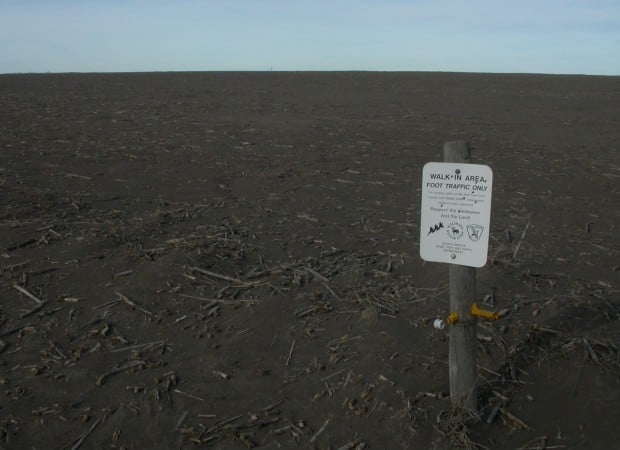
Kevin Woster photo.

The Economist: keep cannabis rules tight

Recognizing the eventuality of the feds relaxing control, regulating Big Dope out of legal cannabis is going to be up to individual states. Interstate commerce is just a matter of time.
Canada’s government plans to legalise cannabis next year, making it the first G7 country to do so. As far as anyone has been able to establish (and some have tried very hard indeed) it is as good as impossible to die of a marijuana overdose. When the prohibition of alcohol ended in 1933, Joseph Choate of America’s Federal Alcohol Control Administration recommended “keeping the tax burden on legal alcoholic beverages comparatively low in the earlier post-prohibition period in order to permit the legal industry to offer more severe competition to its illegal competitor.” But those that legalise early may prove to have a lasting influence well beyond their borders, establishing norms that last for a long while. But as alcohol and tobacco show, tightening regimes at a later date can be very difficult indeed. [excerpt, The Economist]
A gaming compact already exists between tribes and the state just like in other states. The revenue generated should be shared: how hard is that to understand?

South Dakota's legislature can write a bill that would adopt legislation similar to Minnesota's medical cannabis law but worthy of Federal Drug Administration scrutiny where real medicine could be sold by pharmacies. Legalize for adults then allow Deadwood and the tribes to grow under California organic standards then distribute on reservation and off-reservation properties under a compact putting the gaming commission as the administrative body to tax and regulate.

In my view edibles should only be available to patients suffering from debilitating diseases, disorders or conditions then be dispensed by pharmacists and taxed like other prescriptions.
It remains illegal in many states in which the NFL operates, but cannabis has been shown in various studies to help people in two areas of common concern to every NFL player—pain management and the effects of head trauma. [Sports Illustrated]
Home growing for personal enjoyment should look like South Dakota's beer home brewing and wine making laws.

Illegal cannabis growops on national forests cause "significant harm to the land, water and animals."

Just as the federal government has a treaty obligation to provide access to safe and competent medical care for tribes western states have responsibilities to include tribal nations in economic growth.

For the record, I would write very restrictive legislation and present it to Gov. Daugaard before even showing it to the legislature. There was a time when I thought legal cannabis for any application could not pass the legislature and get signed into law. Now, there’s a real chance for all of the above.

2/10/16

Like white on rice: Russell v. Rampelberg

In South Dakota's District 30, obese long-time State Representative Lance Russell says he's challenging sitting State Senator Bruce Rampelberg. Russell is term limited in the SD House. Russell noted today that Rampelberg “has enticed him into the race with less than conservative votes and positions he’s taken such as on medical marijuana, tax increases, and bills such as Rampelberg’s sponsorship of Democrat Bernie Hunhoff’s corporate income tax measure.”

At recent crackerbarrels cracker Russell has been slathering doom on heaps of gloom even as Rampelberg conducted a civil discussion in Pierre today while medical cannabis advocates told their stories.

Also from the Rapid City Journal:
A secretive religious group linked to national cases of polygamy and the marriage of underage girls may be expanding to the Edgemont area, and there may be little Fall River County officials can do. The property in question was part of the estate of Buddy Heck and was left to Doris Seabeck and to Carolyn Fines. Seabeck is Heck’s sister and is the personal representative of his estate. Seabeck signed the purchase agreement, which is being contested by Fines in the courts. The commissioners said that as Carolyn Fines is state’s attorney Lance Russell’s mother, there may be some conflict of interest on the county’s part.
In 2011 Russell was censured by the state's judiciary for leaking grand jury testimony.

Rampelberg has been credited with helping to save Ellsworth Air Force Base from being mothballed.

Conservative means never having to say you're sorry.